




California Meal Penalty Pay Explained for Retail & Non-Exempt Workers
Missing a duty-free meal break during a busy California retail shift is more than just inconvenient.
For many employees, these interruptions represent a direct loss of rest and legal pay. California law requires a duty-free 30-minute meal period for workers who exceed five hours on the job, and employers must pay one extra hour as a penalty for each missed break.
Understanding these regulations helps workers identify violations, assert their rights, and pursue the compensation they deserve.
Defining California Meal Penalty Law
California’s meal penalty law represents a critical worker protection designed to ensure employees receive adequate rest and compensation during long work shifts. Under state regulations, employers must provide nonexempt employees with a duty-free meal period lasting at least 30 minutes when their work day exceeds five consecutive hours.
Meal break regulations from California DIR outline specific requirements that safeguard workers’ rights to uninterrupted breaks.
The fundamental purpose of this law is preventing worker exploitation by mandating employers provide meaningful rest periods. When an employer fails to offer a compliant meal period, they become legally obligated to compensate the employee with one additional hour of pay at their standard hourly rate. This penalty serves as a financial deterrent, encouraging businesses to respect workers’ basic labor rights and provide appropriate meal breaks.
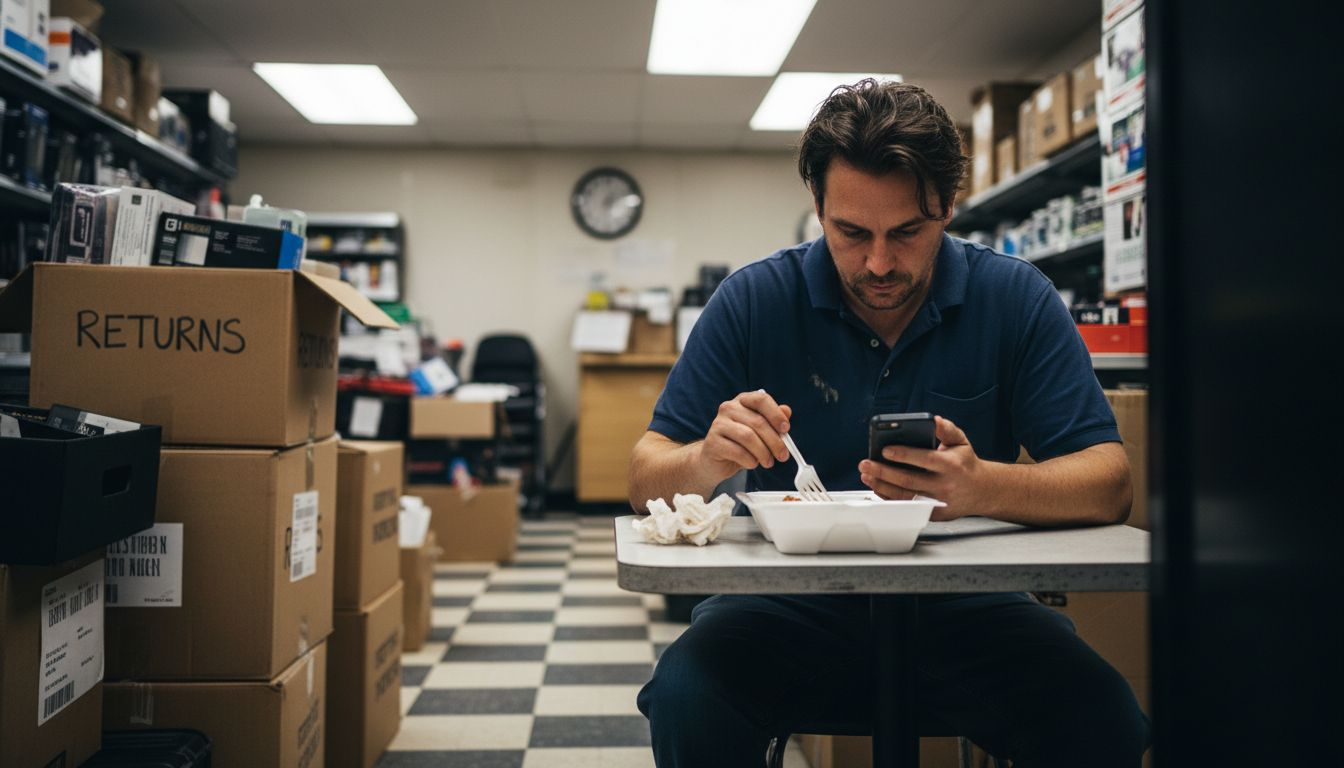
Specifically, the meal period must be truly off-duty, meaning employees must be completely relieved of all work responsibilities during this time. Retail workers in California are particularly protected by these regulations, as the law recognizes the physically and mentally demanding nature of service industry jobs.
The break must be uninterrupted and provide a genuine opportunity for employees to rest, eat, and momentarily disconnect from workplace responsibilities.
Pro tip: Keep detailed personal records of your work shifts and meal breaks, including dates, times, and any instances where a proper meal period was not provided, as these documents can be crucial evidence if you need to file a wage claim.
When Meal Penalties Apply to Workers
California labor laws are designed to protect workers from unfair workplace practices, particularly when it comes to meal breaks. Meal penalty regulations clearly outline specific scenarios where employers must pay additional compensation to employees who are denied proper meal periods.
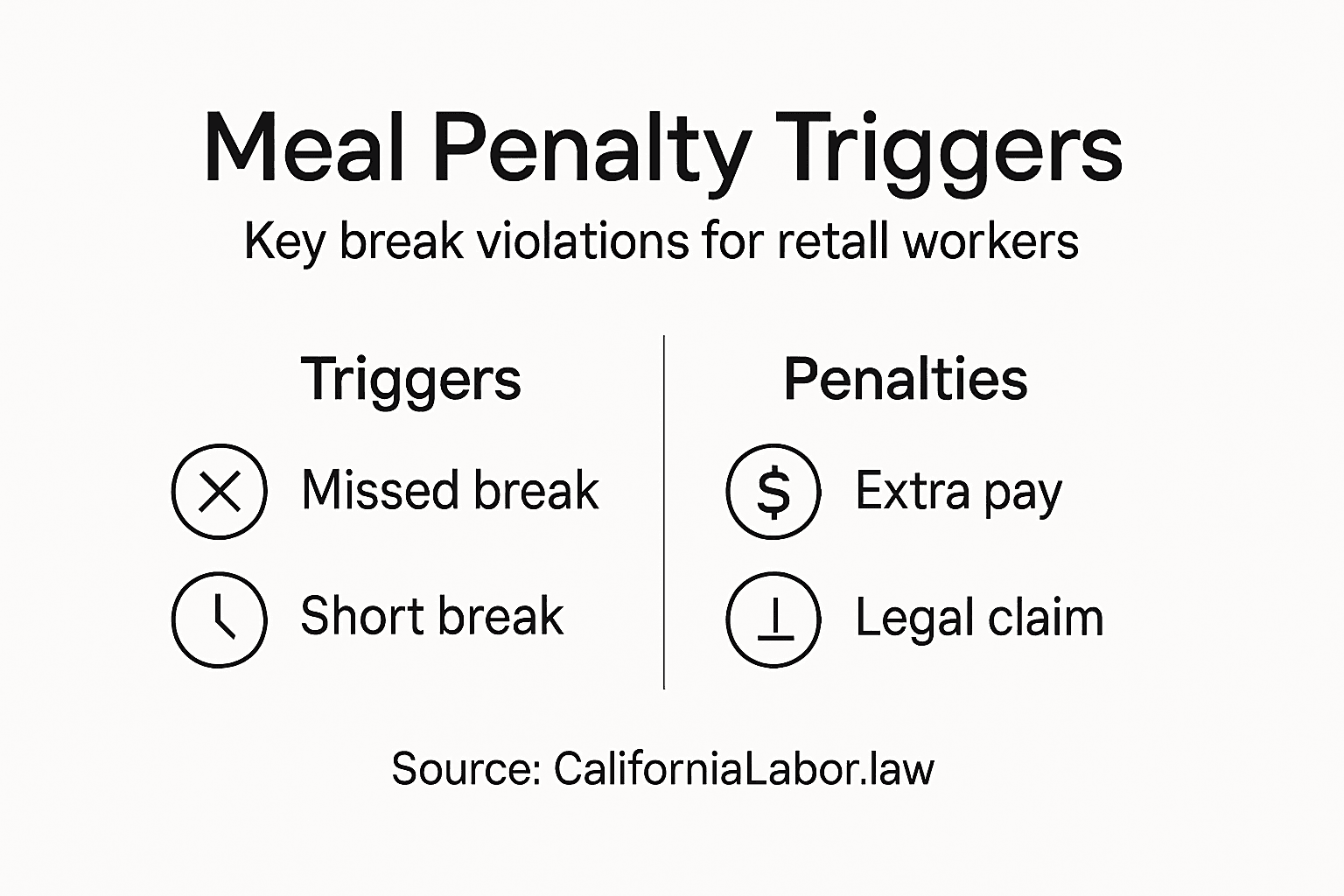
Meal penalties are triggered in several key situations. First, if an employer fails to provide a 30-minute uninterrupted meal break for employees working more than five consecutive hours, they become liable for a one-hour penalty payment.
The penalty also applies when workers are required to remain on-duty during their meal period, effectively preventing them from taking a genuine rest break. This means that simply offering a break is not enough – the break must be truly duty-free and provide a meaningful opportunity for employees to rest and eat.
Retail and service industry workers are particularly vulnerable to meal break violations. Common scenarios that trigger penalties include managers demanding employees work through their scheduled breaks, failing to relieve workers of all job responsibilities during meal periods, or implementing scheduling practices that make taking a full 30-minute break impossible.
Employers cannot create indirect pressures or workplace cultures that discourage workers from taking their legally mandated breaks, as such practices can also result in meal penalty assessments.
Pro tip: Document every instance of a missed or interrupted meal break, including the date, time, duration, and specific circumstances, as these detailed records can be crucial evidence if you need to file a wage claim against your employer.
Key California Legal Requirements for Breaks
California labor laws provide comprehensive protections for workers through detailed meal and rest break regulations. These regulations establish clear guidelines for employers regarding mandatory break periods, ensuring nonexempt employees receive adequate rest during their work shifts.
The law specifically mandates that employees working more than five consecutive hours must receive an uninterrupted 30-minute meal period.
The break requirements are structured with precise timing and duration specifications. For every four hours worked, or substantial fraction thereof, employees are entitled to a 10-minute paid rest break. When an employee works more than five hours, they must receive a first 30-minute meal break, and a second meal break is required if the total work time exceeds ten hours.
Importantly, these breaks must be completely duty-free, meaning the employee must be fully relieved of all work responsibilities during that time.
Employers have specific obligations in implementing these break requirements. They cannot create workplace cultures or scheduling practices that discourage or prevent employees from taking their legally mandated breaks. Breaks cannot be combined or waived without mutual consent, and the timing of breaks must allow meaningful rest.
Some industries with unique operational requirements may have slightly modified break rules, but the fundamental protections remain consistent across most workplace settings.
The table below summarizes key legal requirements for worker breaks in California:
| Requirement Type | Minimum Duration | Applicability | Paid or Unpaid |
|---|---|---|---|
| Meal break | 30 minutes | Over 5 hours worked | Unpaid (unless penalty applies) |
| Rest break | 10 minutes per 4 hours | All nonexempt employees | Paid |
| Second meal break | 30 minutes | Over 10 hours worked | Unpaid |
| Nature of break | Fully duty-free | All workplaces | Required by law |
Pro tip: Photograph or screenshot your work schedule and keep a personal log of your breaks, noting any instances where you were unable to take a full, uninterrupted break, as this documentation can be critical evidence if you need to file a workplace complaint.
How Penalties Are Calculated and Paid
California’s meal penalty system is designed to provide clear financial accountability for employers who fail to comply with break regulations.
Meal break penalty calculations are straightforward: for each day an employee is denied a lawful meal break, they are entitled to one hour of pay at their regular rate as compensation.
The penalty is calculated based on the employee’s standard hourly wage, not their overtime rate. This means if an employee typically earns $20 per hour, they would receive $20 as a penalty for each day a proper meal break is not provided. These penalty payments are considered premium wages and must be included in the employee’s next regular paycheck.
Critically, these penalties are separate from any overtime calculations and cannot be offset or negotiated away by employers.
Employers face significant financial risks for consistent meal break violations. The penalties accumulate quickly – for instance, an employee working five days a week without proper breaks could potentially accrue $100 in daily penalties. These regulations create a strong financial incentive for employers to maintain proper break schedules and respect workers’ rights to rest periods.
The law applies consistently across different industries, though some specific workplace environments might have nuanced interpretations of break requirements.
Pro tip: Keep precise records of your work schedules, break times, and any instances of missed or interrupted breaks, as detailed documentation can be crucial when seeking meal penalty compensation.
Worker Rights and Filing a Meal Penalty Claim
Retail workers in California have robust legal protections when it comes to meal break violations, with clear pathways to seek compensation for denied break rights.
Wage theft protections empower employees to take action when employers systematically violate meal and rest break regulations. Workers have the right to file claims through multiple channels, including direct communication with their employer, filing a complaint with the California Labor Commissioner’s Office, or pursuing legal action through civil courts.
The claims process involves several critical steps. Initially, employees should document all instances of missed or interrupted meal breaks, including dates, times, and specific circumstances of the violation. Workers must typically file a wage claim within three years of the violation, though some situations may have different statute of limitations.
The claim can seek recovery of the one-hour premium pay for each day a proper meal break was not provided, potentially resulting in significant compensation for repeated violations.
Navigating a meal penalty claim requires careful documentation and strategic approach. Employees should maintain detailed records of work schedules, break times, and any communications about missed breaks.
Many workers choose to first address the issue internally with their human resources department or direct supervisor, creating a paper trail of their attempts to resolve the matter. If internal resolution fails, filing a formal complaint with state labor authorities or consulting with an employment law attorney can provide additional avenues for seeking justice and compensation.
Pro tip: Take timestamped screenshots of your work schedules, save text messages or emails discussing break issues, and keep a personal log of every missed or interrupted break, as comprehensive documentation dramatically strengthens your potential claim.
Common Employer Mistakes and Worker Protections
Employers frequently make critical errors in interpreting and implementing California’s meal break regulations, often exposing themselves to significant legal and financial risks.
Meal and rest break requirements reveal numerous common mistakes that can result in substantial penalties for businesses across various industries. These errors typically stem from misunderstandings about break timing, duration, and the mandatory nature of meal periods.
Some of the most prevalent employer mistakes include improperly handling meal break waivers, requiring employees to remain on-duty during breaks, and failing to provide a complete 30-minute duty-free break period. Employers often incorrectly assume they can pressure employees to skip breaks or work during designated rest times.
The law is clear: nonexempt employees must be completely relieved of all work responsibilities during meal breaks, and any attempt to circumvent this requirement can trigger significant financial penalties.
Worker protections are robust and designed to prevent exploitation. Employees have the right to receive full, uninterrupted meal breaks, and employers cannot create workplace cultures that discourage taking these mandated rest periods.
This includes prohibiting indirect forms of pressure, such as scheduling practices that make taking breaks practically impossible or creating environments where workers feel guilty about stepping away from their duties.
The legal framework ensures that workers can assert their rights without fear of retaliation, with multiple mechanisms in place to hold employers accountable for violations.
Pro tip: Create a personal break log documenting the exact times and circumstances of each meal break, including any instances where you were unable to take a full, uninterrupted break, as this documentation can be crucial evidence in potential labor disputes.
Take Control of Your Meal Break Rights Today
Are you a retail worker struggling with missed or interrupted meal breaks in California. Your rights under the meal penalty law are clear You deserve a full 30-minute duty-free meal period without any pressure or interruptions.
The fear of retaliation or the frustration of lost wages can feel overwhelming, but you do not have to face this challenge alone. Find detailed legal guides and tools designed to help you calculate owed wages and assert your rights effectively.
Stop waiting and start reclaiming what is rightfully yours by taking immediate action. Call 1-866-355-9991 now for a free meal penalty consultation and empower yourself with free legal help tailored for California workers like you.
Frequently Asked Questions
What is California’s meal penalty law?
California’s meal penalty law requires employers to provide nonexempt employees with a 30-minute, uninterrupted meal period when working over five consecutive hours. If the law is violated, employers must compensate employees with one additional hour of pay at their regular rate.
When do meal penalties apply to workers?
Meal penalties apply when an employee misses a 30-minute meal break after working over five consecutive hours, is required to stay on-duty during a meal period, or faces indirect pressure to forgo breaks. In these cases, workers are entitled to one extra hour of pay.
What documentation should I keep to file a meal penalty claim?
To file a meal penalty claim, keep detailed records of your work shifts, including dates and times of missed or interrupted meal breaks, as well as any relevant communications. This documentation can serve as critical evidence in your claim.
How are meal penalties calculated and paid?
Meal penalties are calculated at the employee’s standard hourly wage for each day a proper meal break is not provided. This penalty constitutes premium wages and must be included in the employee’s next regular paycheck.