




The EEOC received 88,531 new discrimination charges in FY 2024, a 9.2% jump from the year before (EEOC, 2025). That record number tells you something: workplace violations in California aren’t slowing down, and most workers don’t realize they need legal help until it’s almost too late.
Knowing when to call a California employment lawyer is just as important as knowing who to call. Miss a filing deadline or let evidence go stale and even the strongest case can collapse. This guide walks you through the five clearest warning signs that it’s time to talk to an attorney, the deadlines you can’t afford to miss, and what a free consultation actually looks like.
Key Takeaways
- The EEOC recovered a record $700 million for 21,000+ discrimination victims in FY 2024 (EEOC, 2025).
- California gives you just 3 years to file a FEHA discrimination complaint with the Civil Rights Department.
- Workers with legal representation receive an average wrongful termination settlement of $48,800 vs. $19,200 without a lawyer (Nolo).
- Most California employment lawyers work on contingency (30-40%), meaning you pay nothing upfront.
Listen to this article:
Why Does an Employment Lawyer Matter for Your Case?
The EEOC recovered nearly $700 million for over 21,000 workers in FY 2024 alone (EEOC, 2025). Those recoveries didn’t happen by accident. Employment lawyers specialize in workplace disputes, from unpaid wages to wrongful termination, and they know how to work with both state agencies like the California Civil Rights Department and the federal EEOC.
Here’s something most people don’t realize: in California, you often can’t go straight to court. Many claims require you to first file with a state or federal agency, wait for a right-to-sue letter, and then file your lawsuit within a separate deadline. An employment lawyer manages that entire timeline so you don’t accidentally waive your rights. For a deeper look at what these attorneys handle day to day, see our guide on what an employment attorney does.
Warning Sign 1: Have You Experienced Discrimination or Harassment at Work?
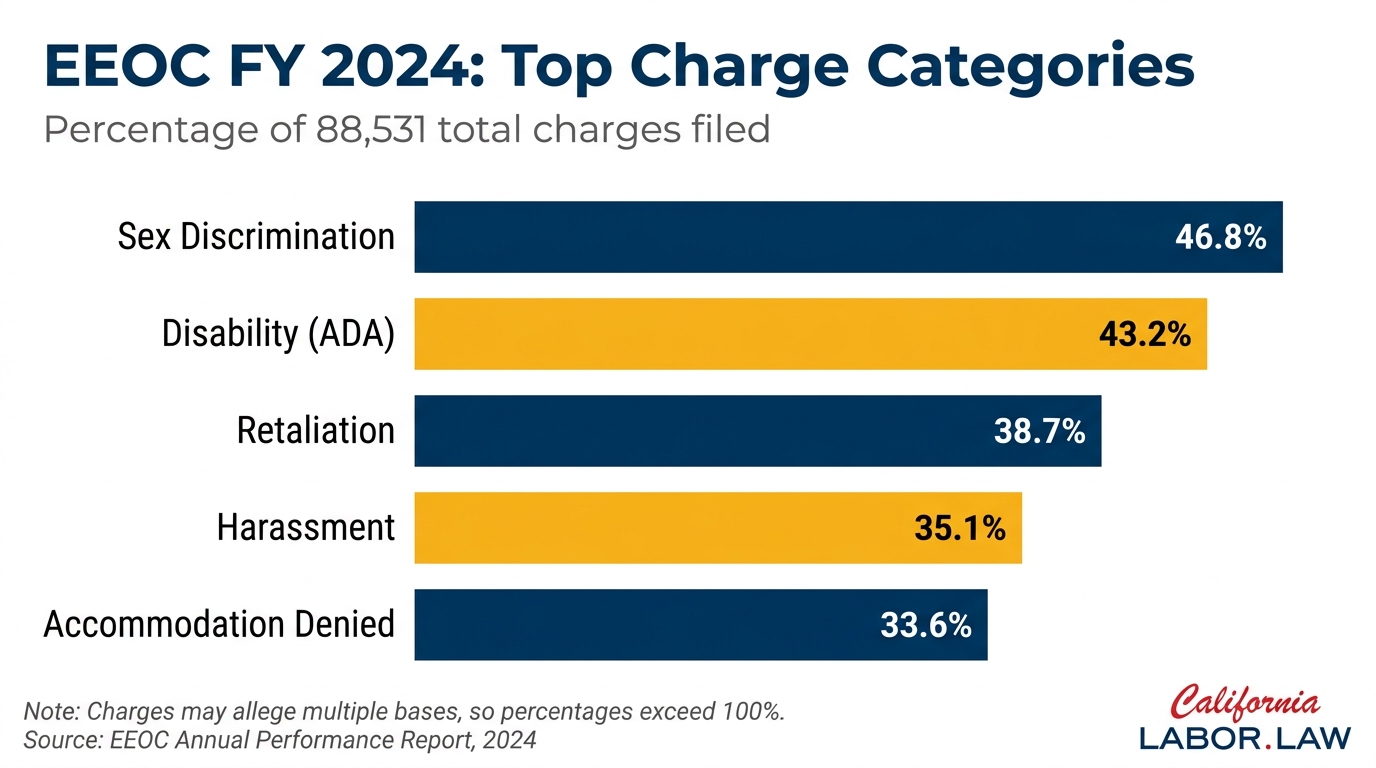
Disability discrimination accounted for 43.2% of EEOC litigation suits filed in FY 2024, making it one of the most common bases alongside sex discrimination at 46.8% (EEOC Office of General Counsel Report, 2025). If you’ve been treated differently because of your race, gender, age, disability, religion, sexual orientation, or national origin, that’s not just unfair. It’s illegal under both California’s Fair Employment and Housing Act and federal civil rights law.
What counts as discrimination in practice? It goes well beyond being called a slur. Watch for these patterns:
- Denied promotions while less-qualified colleagues advance
- Different disciplinary standards applied to you vs. coworkers outside your protected class
- Hostile work environment where offensive conduct is severe or pervasive enough to interfere with your job
- Retaliation after you complained to HR about discriminatory treatment
So how do you know whether your situation crosses the legal line? If HR dismissed your complaint, or if the behavior continues after you reported it, that’s exactly when a lawyer’s assessment becomes essential. Most offer free initial consultations specifically to evaluate whether you have an actionable claim.
Warning Sign 2: Were You Fired and Something Doesn’t Feel Right?
The average wrongful termination settlement in California is roughly $48,800 with legal representation versus $19,200 without, according to a Martindale-Nolo reader survey (Nolo). California is an at-will employment state, meaning your employer can technically fire you for any lawful reason. But “at-will” doesn’t mean “anything goes.”
Your termination may be illegal if it happened because:
- You filed a wage claim or reported safety violations
- You took protected leave under FMLA or the California Family Rights Act
- You refused to participate in illegal activity
- Your employer retaliated against you for a discrimination complaint
- You were replaced by someone outside your protected class shortly after being terminated
Discharge or constructive discharge was alleged in 72.1% of all EEOC charges in FY 2024, making it by far the most common issue workers raise (EEOC, 2025). If your firing felt sudden, suspiciously timed, or pretextual, don’t wait to get a legal opinion.
In our experience, the workers who get the best outcomes are the ones who contact a lawyer within the first two weeks of being fired. Evidence is fresher, witness memories are intact, and you haven’t accidentally signed away rights in a severance agreement.
Just Got Fired? Here’s Your Immediate Action Checklist
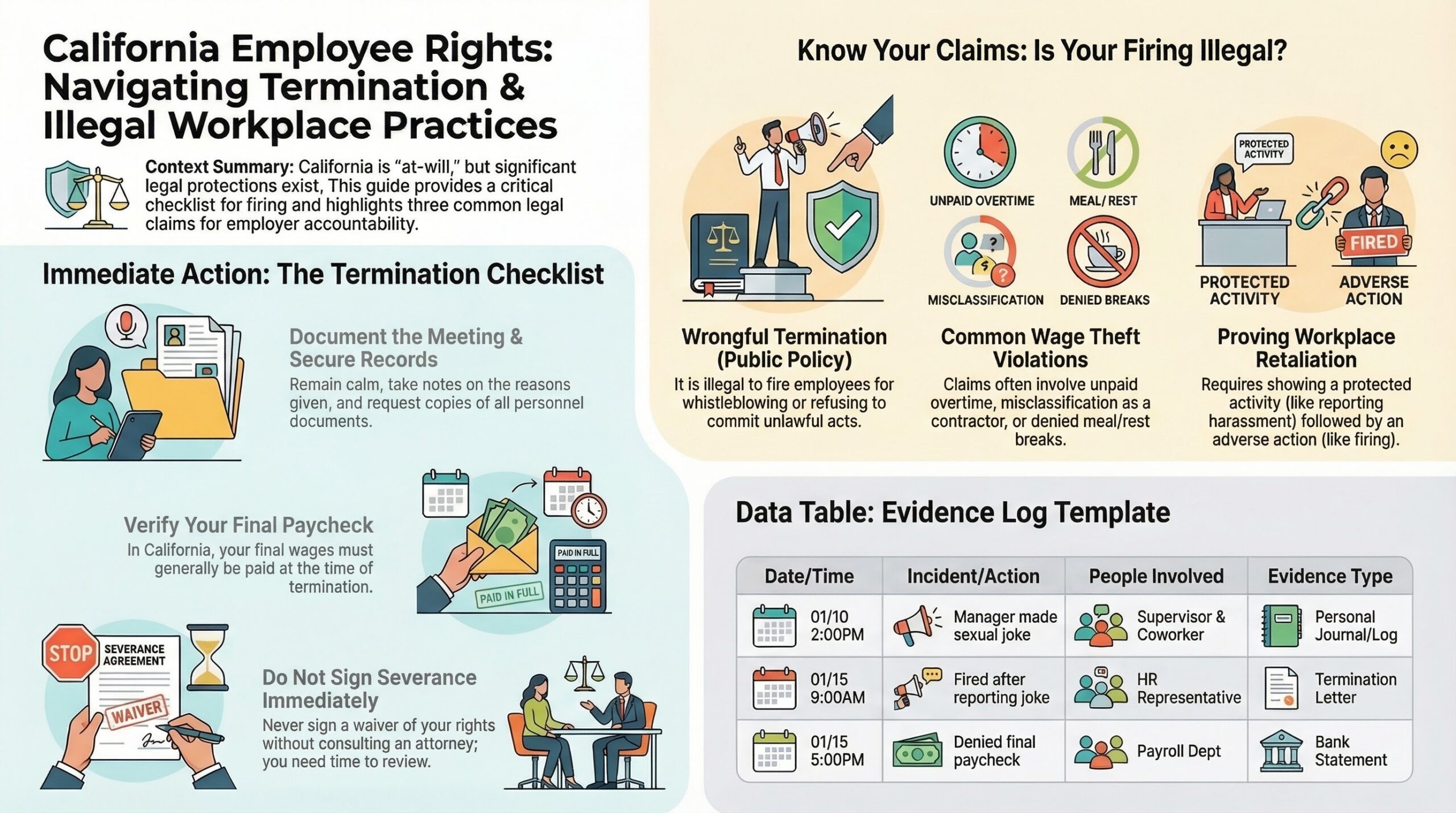
The first 72 hours after being fired are the most important for protecting your legal rights. What you do right now, before you’ve even spoken to a lawyer, can make or break your case. Here’s exactly what to do:
1. Document the Termination Meeting
Stay calm and take mental notes. As soon as you leave, write down everything: who was in the room, what reasons they gave, their exact words if possible, and the time and date. Request copies of all personnel documents before you leave the building, including your personnel file, which you’re entitled to under California Labor Code section 1198.5.
2. Verify Your Final Paycheck
California law requires employers to pay all wages owed at the time of termination, not on the next regular payday. If you were fired, that final check should be immediate. If you quit with 72 hours notice, it’s due on your last day. Late payment triggers wait time penalties of up to 30 days of additional wages.
3. Do Not Sign a Severance Agreement Without Legal Review
This is where many workers lose their claims before they even start. Severance agreements almost always include a release of all legal claims against the employer. You aren’t required to sign on the spot. Take the document home. If you’re over 40, federal law (the Older Workers Benefit Protection Act) gives you 21 days to consider it. Get a lawyer to review it before signing anything.
4. Build Your Evidence Log
Start a personal log tracking every relevant incident. Use this simple format:
| Date/Time | Incident/Action | People Involved | Evidence Type |
|---|---|---|---|
| Example: 01/10, 2:00 PM | Manager made discriminatory comment | Supervisor, coworker witness | Personal journal entry |
| Example: 01/15, 9:00 AM | Fired after reporting the comment | HR representative | Termination letter |
| Example: 01/15, 5:00 PM | Denied final paycheck | Payroll department | Bank statement, pay stub |
Save all evidence to a personal device or account, not your work computer or email. Forward relevant emails to your personal address before you lose access. Screenshots of text messages, photos of workplace postings, and copies of performance reviews all strengthen your case.
In our experience, the employees who build a clear evidence log in those first few days give their attorneys the strongest foundation. Memories fade fast. A detailed, timestamped record written the same day it happened carries far more weight than a recollection six months later.
Warning Sign 3: Is Your Employer Stealing Your Wages?
California workers file roughly 30,000 wage theft claims each year seeking about $320 million in stolen pay, yet they recover only about $40 million, barely 12% of what they’re owed (CalMatters, 2025). That gap is exactly why legal representation matters for wage theft claims. If your paycheck doesn’t match the hours you worked, your employer may be violating California Labor Code sections 510 and 1194.
Common wage theft patterns to watch for:
- Unpaid overtime: California requires 1.5x pay after 8 hours in a day or 40 in a week, and 2x after 12 hours
- Missed meal and rest breaks: Employers owe you one hour of premium pay for each violation
- Misclassification: Being labeled an independent contractor or exempt employee when you shouldn’t be
- Off-the-clock work: Required to answer emails, set up, or clean up without pay
- Tip theft: Employers or managers taking a share of your tips
Should you file on your own or hire a lawyer? For simple wage claims under a few thousand dollars, the DLSE complaint process works well enough. But if your employer owes you significant back wages, misclassified you, or the violation affected multiple employees, a lawyer can pursue a much larger recovery, sometimes as a class action. The California Labor Commissioner’s Bureau of Field Enforcement issued over 2,200 citations between January 2022 and November 2025, recovering $49.1 million in stolen wages and damages (CA DIR, 2025). Imagine what a dedicated attorney could recover for your specific case.
Warning Sign 4: Did Your Employer Retaliate After You Spoke Up?
Retaliation charges accounted for 38.7% of all EEOC filings in FY 2024, making it one of the top three charge categories for seventeen consecutive years (EEOC, 2025). California law explicitly protects employees who report violations, and Labor Code section 1102.5 is one of the strongest whistleblower statutes in the country.
Retaliation doesn’t always look like getting fired. It can be subtle:
- Reduced hours or a sudden shift change
- Exclusion from meetings or projects
- A negative performance review that contradicts prior positive feedback
- Being transferred to a less desirable role or location
- Increased micromanagement or scrutiny that didn’t exist before
What makes retaliation cases particularly strong in California is the timing. If something negative happened within weeks or months of your complaint, that close timing creates a strong inference of retaliation that shifts the burden to your employer to prove a legitimate reason.
Here’s what matters: you don’t have to prove your original complaint was correct to win a retaliation claim. Even if the discrimination you reported turns out not to be legally actionable, your employer still can’t punish you for raising the concern in good faith. That protection alone makes it worth talking to a lawyer if you’ve faced blowback after speaking up.
Warning Sign 5: Are You Running Out of Time to File?
California’s filing deadlines are strict, and missing one can permanently kill your claim, no matter how strong the evidence. The clock starts ticking the day the violation happens, not the day you realize it was illegal.
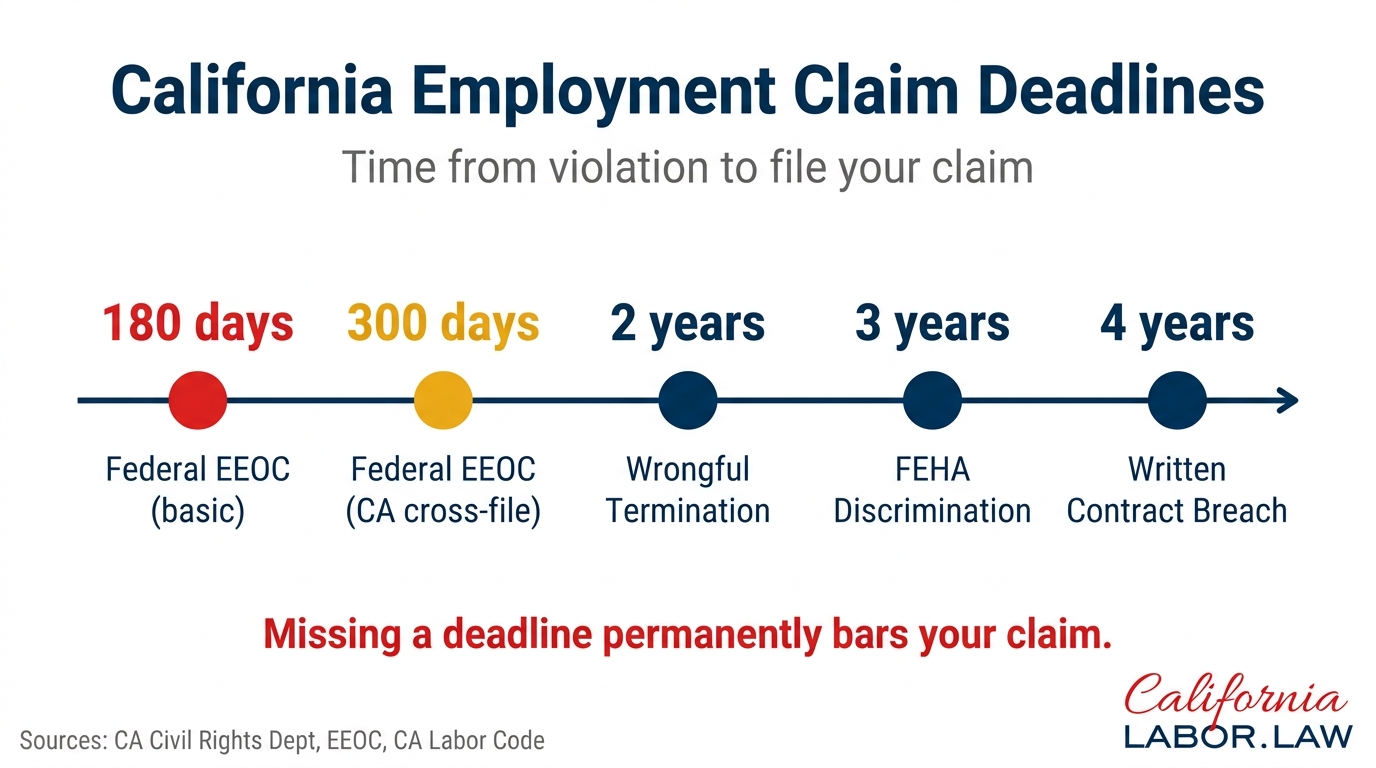
Here are the key deadlines every California worker should know:
| Claim Type | Deadline | Where to File |
|---|---|---|
| FEHA discrimination/harassment | 3 years | CA Civil Rights Dept |
| Wrongful termination (public policy) | 2 years | Superior Court |
| Whistleblower retaliation | 2 years | Superior Court |
| Federal EEOC claims | 300 days (CA cross-file) | EEOC |
| Written contract breach | 4 years | Superior Court |
| Wage claims | 3 years (4 for written contract) | DLSE |
Why does this matter right now? Because multiple deadlines may apply to your situation at the same time. A wrongful termination with a discrimination component means tracking both the 2-year tort deadline and the 3-year FEHA deadline, plus potential federal cross-filing within 300 days. An employment lawyer maps all of these out so nothing slips through.
What Should You Expect During a Free Consultation?
Most California employment lawyers offer free initial consultations, and the majority work on a contingency fee basis, meaning you pay nothing unless they win your case. Under California Business and Professions Code section 6147, contingency agreements must be in writing and the fee is negotiable (State Bar of California, 2025). Contingency fees typically range from 30% to 40% of your settlement or award.
What actually happens in that first meeting? It’s more structured than most people expect:
- You describe the situation and the lawyer listens for legally actionable facts
- They identify which laws apply (FEHA, Labor Code, FLSA, Title VII, etc.)
- They assess the strength of your evidence and identify gaps
- They explain your options: file an agency complaint, negotiate directly, or litigate
- They outline the timeline, including deadlines and likely duration
Bring everything you have. Emails, text messages, pay stubs, performance reviews, your employment contract, any written warnings, and a timeline of events. The more organized you are, the better the lawyer can evaluate your case in that first meeting.

From what we’ve seen, the consultations that go best are the ones where the employee brings a simple one-page timeline: dates, what happened, who was involved. It helps the lawyer spot patterns immediately and gives you a straight answer faster.
Once you’ve found a lawyer you’re comfortable with, the next step is making sure they’re the right fit for your specific case. We’ve put together a detailed guide on 7 expert tips for finding the right California employment lawyer that covers specialization, track records, fee structures, and what to look for in client reviews.
Take Action Now: Protect Your Rights Before Deadlines Pass
Every day you wait is a day closer to a filing deadline. Document everything right now: save emails to a personal account, photograph relevant documents, and write down dates and details while they’re fresh. Don’t discuss your potential claim with coworkers, and avoid signing anything from your employer, especially a severance agreement, without legal review.
Here are your next steps:
- Write a timeline of the key events with dates and names
- Gather documents: pay stubs, emails, texts, reviews, contracts
- Check your deadlines using the table above
- Schedule a free consultation with a California employment lawyer
- Don’t sign anything from your employer until a lawyer reviews it
The EEOC secured $700 million for workers in FY 2024, proving that legal action works. If any of the five warning signs above sound familiar, the next step is a phone call.
Get a free employment law consultation by calling 1-866-355-9991 today.
Frequently Asked Questions About Hiring a California Employment Lawyer
How much does a California employment lawyer cost?
Most California employment lawyers work on contingency, charging 30-40% of your settlement only if they win. That means zero upfront cost for you. Hourly rates, when applicable, typically range from $300 to $500+ per hour depending on experience and location (State Bar of California, 2025). Many firms offer free initial consultations to evaluate your case before any commitment.
What types of cases do California employment lawyers handle?
Employment lawyers handle discrimination, harassment, wrongful termination, wage theft, overtime disputes, retaliation, whistleblower claims, and contract breaches. In FY 2024, the EEOC processed 88,531 new charges with sex discrimination (46.8%), disability claims (43.2%), and retaliation (38.7%) leading all categories (EEOC, 2025).
How long do I have to file an employment claim in California?
It depends on the claim type. FEHA discrimination complaints must be filed within 3 years with the California Civil Rights Department. Wrongful termination claims have a 2-year deadline. Federal EEOC charges must be filed within 300 days in California. Wage claims generally have a 3-year statute of limitations under Labor Code section 338.
What should I bring to my first consultation with an employment lawyer?
Bring your employment contract, recent pay stubs, any written communications (emails, texts, HR complaints), performance reviews, termination letter or severance offer, and a written timeline of key events. The State Bar of California recommends asking about the attorney’s fee structure and experience with similar cases during this first meeting.
Can I sue my employer while still employed?
Yes, California law protects your right to file complaints and lawsuits while employed. Labor Code section 98.6 and section 1102.5 prohibit employers from retaliating against you for exercising legal rights. However, we’ve found that consulting a lawyer before filing helps you prepare for potential workplace tension and document any retaliatory behavior from the start.
What’s the difference between a wage claim and a lawsuit?
A wage claim is filed with the California Division of Labor Standards Enforcement (DLSE) and is handled through an administrative hearing. It’s simpler and doesn’t require a lawyer. A lawsuit is filed in court and typically involves larger amounts or more complex issues like misclassification affecting multiple workers. California workers file about 30,000 wage theft claims per year, but recover only 12.5% of what they seek through the administrative process (CalMatters, 2025), which is one reason many workers choose to hire an attorney for significant claims.