




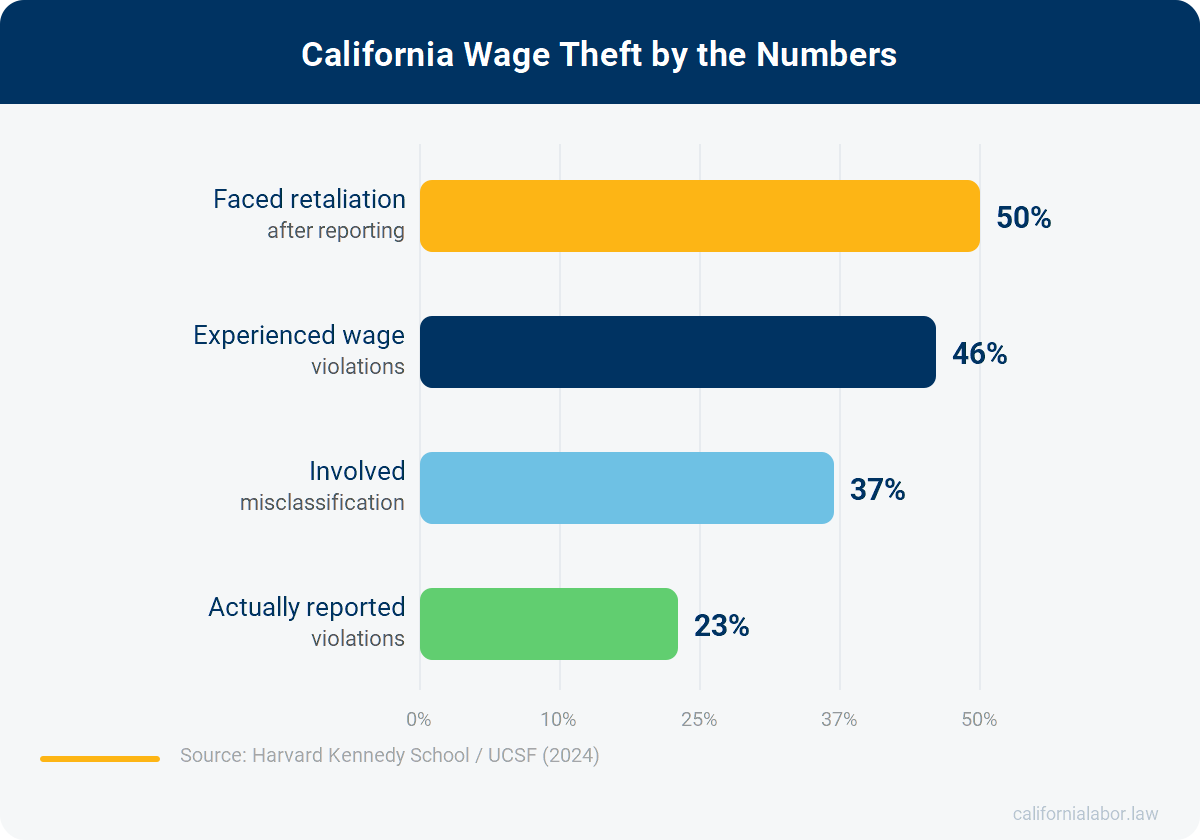
A 2024 study by Harvard Kennedy School and UC San Francisco found that 46% of hourly workers in California experienced at least one serious employment violation in the prior year, including unpaid overtime (Harvard Kennedy School/UCSF, 2024). If your employer isn’t paying you correctly for hours worked beyond eight in a day or 40 in a week, you likely need a California overtime lawyer.
Most workers don’t realize they’re being shortchanged until the losses add up to thousands. Here’s how to tell whether it’s time to call a lawyer, what California overtime law actually requires, and how much you could recover.
Key Takeaways
- California overtime kicks in after 8 hours/day (not just 40/week like federal law), and the 2026 minimum overtime rate is $25.35/hour (DIR, 2026).
- Workers in California’s four largest metro areas lose $2.3 to $4.6 billion annually to wage theft (Rutgers Workplace Justice Lab, 2023).
- You have 3 years to file an overtime claim (4 years if it involves unfair business practices).
- Average individual overtime settlements range from $25,000 to $100,000, with class actions reaching millions.
- Most California overtime lawyers work on contingency, so you pay nothing unless you win.
What Are the Warning Signs You Need an Overtime Lawyer?
Only 23% of California workers who experienced wage violations actually reported them, according to the Harvard/UCSF survey. Over 50% of those who did report faced retaliation. That gap between violations happening and workers taking action is exactly why overtime lawyers exist.
You should talk to an overtime lawyer if any of these situations sound familiar:
- You work more than 8 hours a day without extra pay. California’s daily overtime threshold catches violations that federal law misses entirely.
- Your employer labels you “exempt” or “salary” but you don’t manage anyone. In 2023, 37% of the 12,000 wage violation cases filed with the California Labor Commissioner involved employee misclassification (CA Labor Commissioner, 2023).
- You’re asked to work off the clock. Checking emails before your shift, staying late to close up, or working through lunch all count as compensable time.
- Your employer changed your time records. Altering timesheets is illegal under California Labor Code Section 1174.
- You experienced retaliation after asking about overtime. Employers who punish workers for raising overtime questions violate Labor Code Section 98.6.
- You’re an independent contractor who works set hours at one company. Under California’s AB 5 and related laws, you may actually be an employee entitled to overtime.
Don’t wait for the situation to resolve itself. The longer you delay, the more wages you lose and the closer you get to the statute of limitations.
What Does California Overtime Law Require in 2026?
California’s overtime protections are among the strongest in the country. As of January 1, 2026, the state minimum wage is $16.90 per hour, which sets the minimum overtime rate at $25.35/hour (1.5x) and double time at $33.80/hour (2x) (California DIR, 2025).
Under Labor Code Section 510, here’s when overtime and double time apply:
| Rule | California (2026) | Federal (FLSA) |
|---|---|---|
| Daily overtime trigger | After 8 hours (1.5x rate) | No daily overtime requirement |
| Weekly overtime trigger | After 40 hours (1.5x rate) | After 40 hours (1.5x rate) |
| Double time | After 12 hours/day (2x rate) | No double time requirement |
| 7th consecutive day | First 8 hrs at 1.5x, then 2x | No 7th-day rule |
| Exempt salary threshold | $70,304/year ($5,858.67/month) | $35,568/year ($684/week) |
| Statute of limitations | 3 years (4 with UCL claims) | 2 years (3 if willful) |
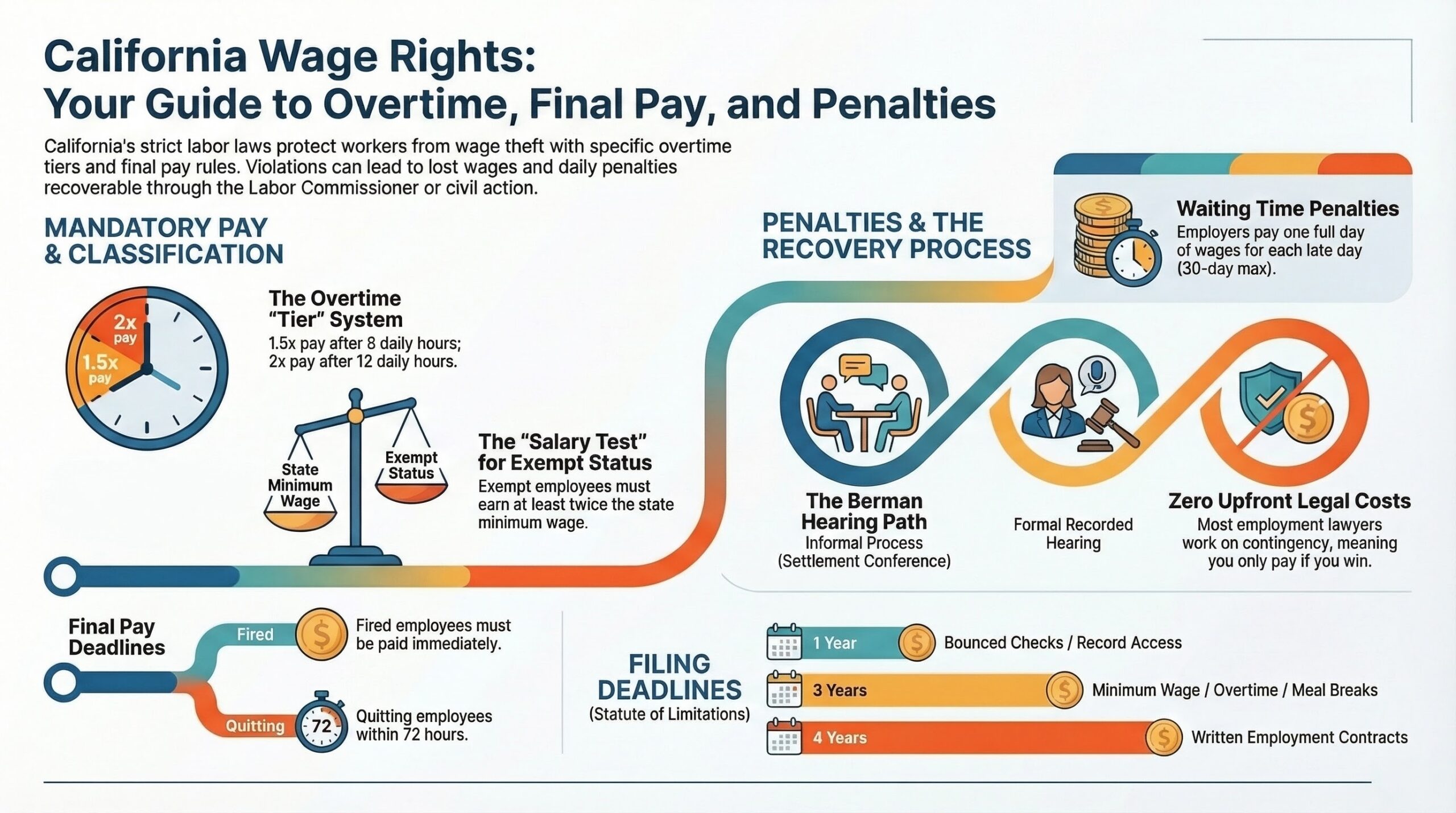
Notice the differences? A worker putting in 10-hour days but staying under 40 hours a week would get zero overtime under federal law. Under California law, they’d earn 1.5x pay for those extra 2 hours every single day. That’s why California-specific legal expertise matters.
How Much Could You Be Owed? A 2026 Overtime Calculation
The Rutgers Workplace Justice Lab found that affected workers lost roughly 20% of their total paychecks to wage theft on average, with full-time workers losing about $4,000 per year (Rutgers, 2023). Here’s what a real-world scenario looks like with 2026 numbers.
Example: Maria earns $20/hour and works 10-hour shifts, 5 days a week.
| Hours | Rate | Pay |
|---|---|---|
| First 8 hrs/day x 5 days = 40 hrs | $20.00 (regular) | $800.00 |
| Extra 2 hrs/day x 5 days = 10 hrs OT | $30.00 (1.5x) | $300.00 |
| Total correct weekly pay | $1,100.00 | |
| What employer pays without OT | $20.00 x 50 hrs | $1,000.00 |
| Weekly underpayment | $100.00 |
That’s $100 per week. Over a year, Maria loses $5,200. Over the 3-year statute of limitations, she’s owed $15,600 in unpaid overtime alone, before penalties and interest.
And that’s a modest scenario. Workers earning more than minimum wage or pulling 12-hour shifts (triggering double time) can be owed significantly more. Have you run the numbers on your own situation?
What Are the Most Common Overtime Violations?
California employers owe workers billions in stolen wages every year. The Rutgers Workplace Justice Lab documented that workers across California’s four largest metro areas lost between $2.3 billion and $4.6 billion annually to wage theft between 2014 and 2023, with minimum wage violations nearly doubling over that period (Rutgers, 2023).
The violations that an overtime lawyer sees most often include:
Misclassification as exempt. Your employer calls you “salaried” or “manager” to avoid paying overtime. In 2026, an exempt employee must earn at least $70,304 per year and perform specific executive, administrative, or professional duties (DIR, 2026). A title alone doesn’t make you exempt.
Off-the-clock work. Employers who expect you to answer emails, set up equipment, or attend meetings before clocking in owe you for that time. Period.
Altered time records. Some employers shave minutes or round hours down. If your paystub doesn’t match your actual hours, that’s wage theft under Labor Code Section 1174.
Denied meal and rest breaks. Missed breaks trigger premium pay of one additional hour at your regular rate. These premiums often stack on top of overtime violations.
Independent contractor misclassification. Under California’s ABC test, you’re likely an employee unless your employer can prove otherwise. Workers who set their own schedules, use their own tools, and perform work outside the company’s core business may qualify as independent contractors. Most don’t.
Los Angeles has the highest rate of wage theft nationally, with workers losing an estimated $1.6 to $2.5 billion annually in that metro area alone.
Should You File a Claim Yourself or Hire a Lawyer?
You actually have three options for recovering unpaid overtime in California, and the right choice depends on how much you’re owed and the complexity of your situation.
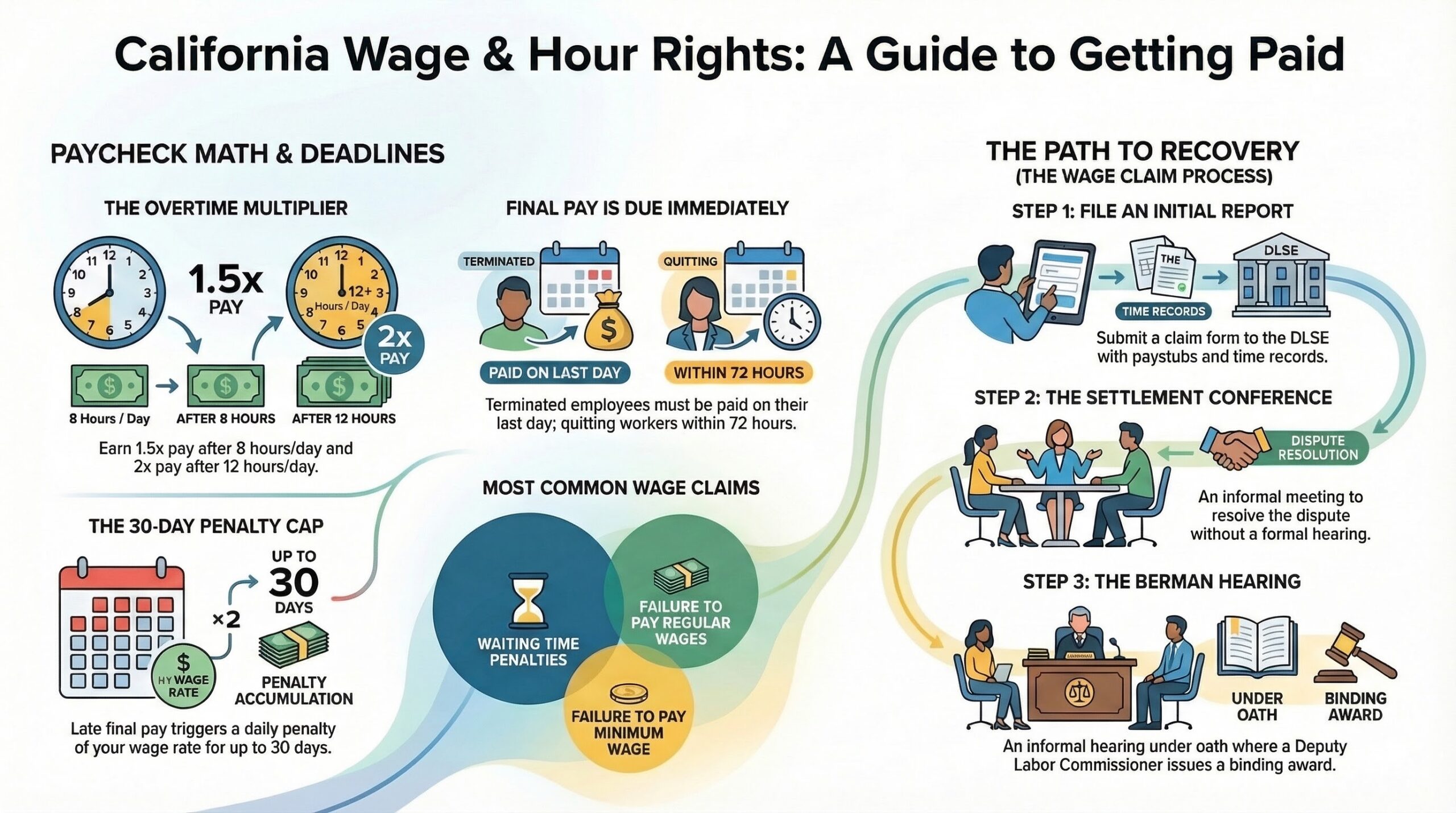
Option 1: File a wage claim with the Labor Commissioner (DLSE). This is free, doesn’t require a lawyer, and works well for straightforward claims. You file a claim, attend a settlement conference, and if that fails, go to a hearing. The state invested $18 million through its Workers’ Rights Enforcement Grant Program to boost enforcement capacity in 2024-2026 (DIR, 2024).
Option 2: File a lawsuit with a private attorney. Better for larger claims, systemic violations, or when you need stronger legal firepower. Attorneys can pursue additional penalties, interest, and attorney’s fees that boost your recovery.
Option 3: File a PAGA claim. The Private Attorneys General Act lets you sue on behalf of yourself and other employees. As of the 2024 PAGA reforms, employees receive 35% of penalties (up from 25%), with the state getting 65% (Cal Employment Law Report, 2026). PAGA claims have a 1-year statute of limitations and require you to have personally experienced the violations.
When does hiring a lawyer make the most sense? If your claim involves misclassification, retaliation, multiple violation types, or amounts exceeding the $10,000 small claims limit, an attorney’s expertise typically delivers a better outcome. Most California overtime lawyers take cases on contingency, meaning you pay nothing upfront and they collect a percentage only if you win.
What’s the Deadline to File an Overtime Claim?
Miss your deadline and you lose your claim entirely, no matter how strong it is. California has different statutes of limitations depending on the type of claim:
- 3 years for unpaid overtime based on a state statute violation (Labor Code Section 510)
- 4 years if you add an Unfair Competition Law claim under Business and Professions Code Section 17200
- 1 year for PAGA claims (from the date of the most recent violation you experienced)
- 1 year for waiting time penalties under Labor Code Section 203
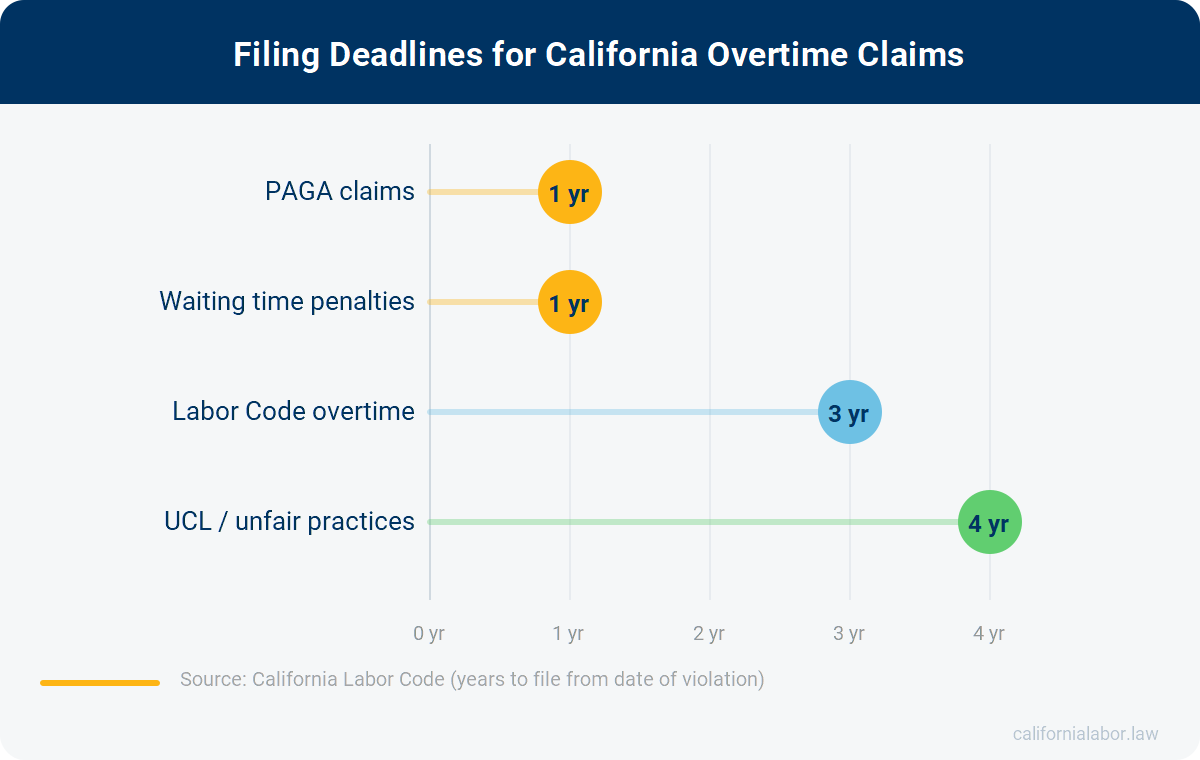
Here’s what matters practically. An experienced California employment lawyer will often file under both the Labor Code and the UCL, stretching the recovery window to 4 years. On a claim worth $5,200 per year, that extra year of back pay adds up fast.
The clock starts running from the date of each individual violation, not the date you discovered it. So every week that passes without filing is a week of unpaid overtime that falls off the back end of your claim.
How Much Can You Recover in an Overtime Case?
Settlement amounts vary widely based on the violation’s scope and duration. Based on 2024-2025 case data, here’s what California workers have recovered:
- Individual claims: $25,000 to $100,000 for multi-year violations with a single employer
- Small-scale violations: $6,000 to $50,000 for shorter-term or less severe underpayment
- Systematic wage theft: $50,000 to $300,000 when violations are company-wide over extended periods
- Class actions: $300,000 to hundreds of millions in large-scale cases
To put those numbers in context: Disney agreed to a $233 million settlement in late 2024 for wage theft affecting Disneyland Resort workers, the largest wage-and-hour payout in California history. G4S Secure Solutions paid $130 million on behalf of 13,500 security guards for unpaid breaks.
According to the Rutgers Workplace Justice Lab, California workers affected by wage theft lost roughly 20% of their total paychecks, with full-time workers losing an average of $4,000 per year (Rutgers, 2023). Combined with penalties under Labor Code Section 203 (up to 30 days of wages for late final paychecks) and attorney’s fees, total recoveries often exceed the unpaid wages themselves.
Your recovery typically includes unpaid overtime, interest, waiting time penalties, liquidated damages (which can double your award in certain cases), and attorney’s fees paid by the employer.
How Does Working with an Overtime Lawyer Actually Work?
If you’ve never hired a lawyer, the process is more straightforward than you’d expect. Here’s the typical timeline:
Step 1: Free consultation. You describe your situation. The lawyer reviews your pay stubs, work schedule, and job duties to determine if you have a claim. This costs nothing.
Step 2: Document gathering. Your lawyer collects evidence: timesheets, pay stubs, employment contracts, emails, and any communications about overtime. Start saving these now if you haven’t already.
Step 3: Demand letter. Many cases settle here. Your lawyer sends a formal demand to your employer outlining the violations and the amount owed. Employers often prefer settling quietly over litigation.
Step 4: Filing a claim or lawsuit. If the employer doesn’t cooperate, your lawyer files with the Labor Commissioner or in Superior Court. The choice depends on the claim size and complexity.
Step 5: Negotiation or trial. Most overtime cases settle before trial. Your lawyer handles all negotiations, and you’re kept informed throughout.
What should you do right now if you suspect unpaid overtime? Start a personal log of your actual hours worked. Save every pay stub. Screenshot any texts or emails where your employer asks you to work off the clock. This evidence is gold for your case.
Frequently Asked Questions About California Overtime
Is overtime pay mandatory in California?
Yes. California Labor Code Section 510 requires all employers to pay non-exempt employees overtime for hours worked beyond 8 in a single workday or 40 in a workweek. The overtime rate is 1.5 times the employee’s regular rate. Double time (2x) applies after 12 hours in a day. There are no exceptions based on employer size.
How do I know if I’m exempt from overtime in California?
To qualify as exempt from overtime in California, you must earn at least $70,304 annually (as of 2026), perform executive, administrative, or professional duties, and regularly exercise independent judgment. A job title alone doesn’t determine exemption status. If your employer simply changed your title to “manager” without changing your duties or salary, you may be misclassified.
How is overtime calculated in California?
Your overtime rate is based on your “regular rate of pay,” which includes your hourly wage plus non-discretionary bonuses, commissions, and certain other compensation. Overtime is calculated at 1.5x your regular rate for hours 9 through 12 in a workday, and 2x your regular rate for hours beyond 12. On the 7th consecutive workday, the first 8 hours are paid at 1.5x and hours beyond 8 at 2x.
Can my employer retaliate against me for filing an overtime claim?
No. California Labor Code Section 98.6 makes it illegal for employers to retaliate against workers who file wage claims. Retaliation includes termination, demotion, reduced hours, or any other adverse action. If retaliation occurs, you may be entitled to additional damages including reinstatement, back pay, and a penalty of up to $10,000. Document any changes in treatment immediately and consult an attorney.
What’s the difference between a PAGA claim and an individual overtime lawsuit?
An individual overtime lawsuit recovers your personal unpaid wages, penalties, and interest. A PAGA claim lets you act as a “private attorney general” to enforce labor laws on behalf of all affected employees. Under 2024 PAGA reforms, employees receive 35% of civil penalties. PAGA has a shorter 1-year statute of limitations but can produce larger total recoveries when violations are widespread.
How long do I have to file an overtime claim in California?
You have 3 years from the date of each violation to file an unpaid overtime claim under California Labor Code. If your attorney adds an Unfair Competition Law claim (Business and Professions Code Section 17200), the window extends to 4 years. PAGA claims have a 1-year deadline. Because each missed paycheck is a separate violation, the clock is always running. Filing sooner means recovering more.
Do California overtime lawyers charge upfront fees?
Most California overtime lawyers work on a contingency fee basis. You pay nothing upfront and no fees unless they win your case. The attorney’s percentage typically ranges from 25% to 40% of the total recovery. Many also advance litigation costs. This arrangement means there’s no financial barrier to pursuing your claim, and your lawyer is directly motivated to maximize your recovery.
Take Action to Protect Your Wages
California’s overtime laws are strong, but they only protect you if you enforce them. With nearly half of hourly workers experiencing wage violations and only 23% reporting them, billions in earned wages go uncollected every year.
If you suspect your employer owes you overtime, don’t wait. Start documenting your hours, save your pay stubs, and talk to a California overtime lawyer. The consultation is free, most attorneys work on contingency, and you have a limited window to file your claim.
Contact California Labor Law for a free employment law consultation by calling us at 1-866-355-9991.