




Non-Compete Contracts in California: Legal or Not? (Complete Guide)
Facing a new job offer or exit in California can leave employees in technology and healthcare wondering if a non-compete agreement will limit their next career step.
Understanding California’s strict prohibition on non-compete agreements is crucial, especially with so many contracts still including these clauses despite clear state law.
This guide provides concise, up-to-date answers so you can approach your next move with confidence and protect your right to work.
What Are Non-Compete Contracts?
Non-compete contracts are legal agreements that restrict employees from working for competitors or starting similar businesses after leaving their current employment. These contractual provisions protect business interests by limiting an employee’s professional activities for a specified duration and geographic region.
Typically, non-compete contracts contain several key components that define their scope and enforceability:
- Duration of restrictions (usually 6-24 months)
- Geographic limitations defining where restrictions apply
- Specific competitive activities prohibited
- Potential financial penalties for violation
- Compensation considerations for the employee
Business motivations for non-compete agreements are complex. They aim to prevent employees from immediately transferring specialized knowledge, client relationships, or proprietary strategies to direct competitors. These agreements are intended to protect employer investments in human capital, particularly in industries where intellectual property and specialized skills are critical.
However, non-compete contracts are not universal or unconditionally enforceable. Different states have varying regulations, with California being notably strict about limiting such contractual restrictions. The primary goal is balancing legitimate business protection with an employee’s right to pursue professional opportunities.
Pro tip: Always carefully review the specific terms of any non-compete agreement and consider consulting an employment lawyer to understand potential implications for your career trajectory.
California Law on Non-Compete Agreements
California stands out as a unique state with an exceptionally strict stance on non-compete agreements. California law explicitly prohibits employers from enforcing non-compete agreements, making these contracts essentially unenforceable across most industries and employment scenarios.
The key aspects of California’s legal approach to non-compete contracts include:
- Complete prohibition of most non-compete agreements
- Protection of worker mobility and professional freedom
- Rejection of geographic or time-based restrictions on employment
- Severe penalties for employers attempting to enforce such agreements
- Strong legal support for employees’ right to work
Under California Business and Professions Code Section 16600, the state takes an unequivocal position that any contract restraining an individual from engaging in a lawful profession, trade, or business is void.
This means that regardless of how an employer drafts a non-compete clause, California courts will typically invalidate such provisions, prioritizing an employee’s right to earn a living and maintain professional opportunities.

Federal regulations are also aligning with California’s worker-friendly approach, with the Federal Trade Commission recently proposing rules that would significantly limit non-compete agreements nationwide. This trend underscores California’s long-standing commitment to protecting worker mobility and preventing anti-competitive business practices.
Pro tip: Always request a copy of your employment contract and have it reviewed by a local employment attorney to understand your specific rights under California law.
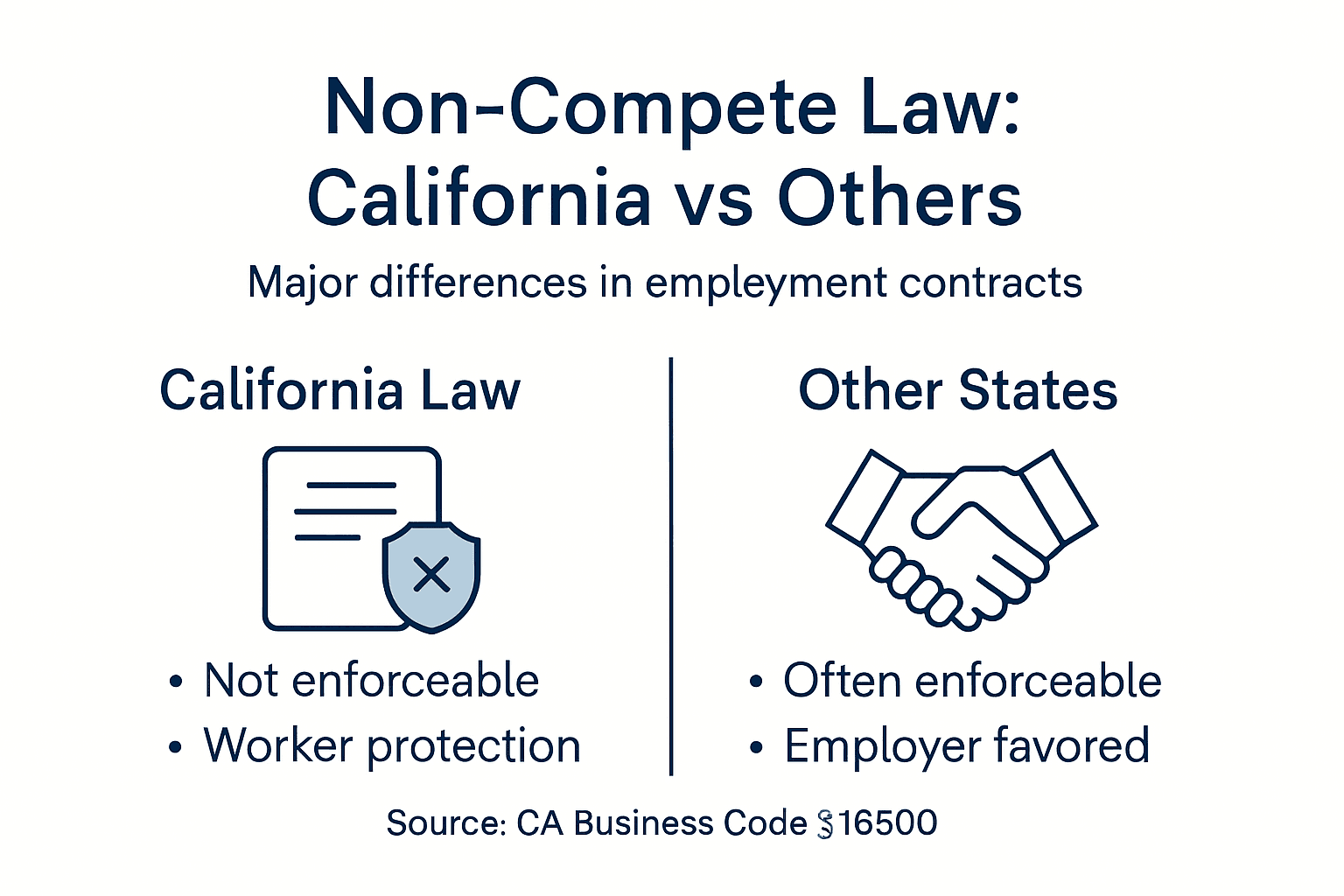
Here’s how California’s approach to non-compete contracts compares with the general U.S. legal landscape:
| Aspect | California Law | Most Other States |
|---|---|---|
| Enforceability | Void in nearly all cases | Often enforceable with limits |
| Worker Mobility | Fully protected | Limited by contract terms |
| Employer Penalties | Severe sanctions possible | Typically minor or none |
| Use of Alternatives | Focus on NDAs, IP laws | Alternatives plus non-competes |
Exceptions: Trade Secrets and Non-Solicitation
While California’s stance against non-compete agreements remains firm, the state recognizes legitimate business interests that require protection. Employers can still safeguard critical business assets through carefully crafted legal mechanisms, specifically focusing on trade secrets and client relationships.
The key alternative legal protections for businesses include:
- Non-disclosure agreements (NDAs) that prevent information sharing
- Non-solicitation clauses targeting client and employee poaching
- Trade secret protection under state and federal laws
- Confidentiality contracts with specific legal boundaries
- Intellectual property safeguards that don’t restrict employment
Trade secret protection represents the most robust exception to California’s non-compete restrictions. Businesses can take legal action if an employee misappropriates confidential information, technical processes, or proprietary strategies.
This means while an employer cannot prevent you from working for a competitor, they can absolutely pursue legal remedies if you steal or improperly use their confidential information.
Non-solicitation agreements provide another nuanced approach to protecting business relationships, allowing companies to prevent former employees from directly soliciting clients or other employees. These agreements must be narrowly crafted to avoid being interpreted as de facto non-compete contracts, which California courts will swiftly invalidate.
Pro tip: Always carefully read the specific language of any confidentiality or non-solicitation agreement, and consider consulting an employment lawyer to understand your precise obligations.
Here are the main legal alternatives California employers use instead of non-compete agreements:
| Method | Primary Purpose | Risk to Employee | Common Use Case |
|---|---|---|---|
| Non-Disclosure Agreement (NDA) | Prevent secret info sharing | Requires ongoing confidentiality | Protecting client lists or formulas |
| Non-Solicitation Clause | Prevent poaching clients or staff | Restrictions must be narrow | Retaining customers or teams |
| Trade Secret Protection | Secure proprietary business data | Legal action if misappropriated | Technology or product design |
| Confidentiality Contract | Limit disclosure of sensitive data | Clarifies information boundaries | General business operations |
Employee Rights and Employer Obligations
California workers have robust legal protections against anti-competitive employment restrictions, ensuring their fundamental right to pursue professional opportunities without undue constraints.
The state’s legal framework prioritizes employee mobility and career freedom, placing significant responsibilities on employers to respect these rights.
Key employee rights and employer obligations include:
- Right to work in chosen profession without unreasonable restrictions
- Prohibition of anti-competitive employment agreements
- Protection against wage suppression tactics
- Freedom to seek better employment opportunities
- Legal recourse for workers facing unfair labor practices
Employer obligations are comprehensive and strictly enforced. Businesses cannot create, enforce, or imply non-compete agreements that restrict an employee’s ability to work. This means employers are legally prohibited from developing contract language that could discourage or prevent workers from changing jobs, even within the same industry or with direct competitors.
California’s Department of Justice actively monitors and enforces worker protection standards, ensuring that companies maintain fair labor practices. Employers who violate these standards can face significant legal penalties, including potential lawsuits, financial sanctions, and reputational damage.
The state’s commitment to protecting worker mobility extends beyond merely invalidating non-compete agreements to actively preventing any practices that might limit professional opportunities.
Pro tip: Document any suspicious contract language or employment practices that seem designed to restrict your career mobility, and consider consulting an employment lawyer if you feel your professional rights are being compromised.
Recent Legal Changes Affecting Non-Competes
California has strengthened its legal stance against non-compete agreements with significant legislative updates effective January 1, 2024. These changes represent a comprehensive approach to protecting worker mobility and preventing anti-competitive employment practices across the state.
The key recent legal modifications include:
- Complete prohibition on drafting or enforcing non-compete agreements
- Expanded worker protection mechanisms
- Increased penalties for employers attempting to restrict employee movement
- Retroactive invalidation of existing non-compete contracts
- Enhanced legal recourse for workers facing contractual restrictions
Statutory updates dramatically transform the legal landscape for employment contracts. Employers are now explicitly forbidden from not only enforcing non-compete agreements but also from attempting to create or negotiate such provisions.
This represents a more aggressive approach compared to previous interpretations of California’s long-standing prohibitions against restricting worker mobility.
Multistate legal coalitions are actively supporting nationwide efforts to ban non-compete agreements, signaling a broader movement toward protecting employee rights.
California continues to lead these efforts, with Attorney General Rob Bonta playing a prominent role in supporting federal initiatives that would extend similar protections across the United States.
Pro tip: Review any existing employment contracts with a legal professional to ensure they comply with the latest California non-compete regulations and do not contain any potentially unenforceable restrictive provisions.
Understand Your Rights and Protect Your Future in California
Navigating non-compete agreements in California can be confusing and stressful, especially with strict laws that often render these contracts unenforceable.
If you are concerned about your employment contract, confidentiality clauses, or non-solicitation terms, you are not alone. Knowing your rights under California labor law is essential to safeguard your career mobility and prevent unlawful restrictions on your ability to work.
At California Labor Law, we provide clear, reliable guidance tailored to California employees facing these challenges.
Do not let confusing agreements limit your professional opportunities. Call 1-866-355-9991 today to schedule a free non-compete contract consultation and empower yourself with knowledge and get the support you deserve to stand up for your rights.
Frequently Asked Questions
Are non-compete contracts enforceable in California?
Non-compete contracts are generally void in California, making them unenforceable across most industries and employment scenarios.
What legal protections do employees have regarding non-compete agreements in California?
California law protects employees’ rights to work without unreasonable restrictions, prohibiting anti-competitive agreements like non-compete contracts.
What are the exceptions to non-compete restrictions in California?
While non-compete agreements are typically unenforceable, businesses can protect trade secrets and client relationships through non-disclosure agreements (NDAs) and non-solicitation clauses.
What recent changes have been made to non-compete laws in California?
As of January 1, 2024, California has strengthened its prohibition against non-compete agreements, including increased penalties for violations and retroactive invalidation of existing contracts.